
Earth
Of course we had to start with our beautiful, exclusive planet, our unique blue sphere with variable patches of white floating in space with its equally unique crowd of inhabitants.
Are we alone in the universe? We don’t know. It seems pretentious to believe so, but so far, there is no competition in sight.
However, our goal here today is not to talk planets, satellites, universes, that kind of stuff, but to describe and exalt life on this planet, particularly, according to a Brazilian saying (referring to Brazil, of course), the South Carolinian land “where if you plant, everything grows.”
In our particular case, a clay soil — that’s the easy part — with a lot of stones, big stones, and I mean, big. Every hole you dig you run the risk of reaching something extremely hard that needs to be forcibly extracted and replaced by some garden soil from the nursery, so you can rightfully and unconditionally say that this is “a place where, if you plant, everything grows.”
Of course we want to grow extraneous bulbs, roses, and one of my not-so-easy favorites, alstroemerias. But the truth is, if you really wanted and worked on it, you could certainly create a garden just by collecting and transplanting the super rich and varied wildflowers of South Carolina, which you can find described in detail in this beautiful book, A Guide to the Wildflowers of South Carolina, which my husband bought as a gift to… our next-door neighbor a few years ago.
Am I jealous? Of course I am!
We do keep a beautiful wildflower meadow on the side of our house, mixing SC and non-SC species and watching them fight for survival to see who finally wins, year after year, after a mystifying spring season filled with the species we brought in. As the season advances, the jungle progressively takes over, until, after mid-August, you can’t even go there.
Our neighbor, the fortunate recipient of that precious book, keeps a wildflower garden in front of his house and, let me tell you, he has some beautiful species there, but the “jungle effect” takes over all the same, and it’s not exactly a pretty picture… for the front of a house.
We still owe our dedicated very few readers — and I hope this will change shortly — a “walk in Noga’s garden” dutifully recorded on video, but this will have to be postponed until next spring.
It’s already too late now. I hope you stick around and our readership grows healthily until then, to join “we few, we happy few, we band of brothers.” And sisters, of course.
Wind
Ah, the Paris Mountain wind. It sings, you know, and it can get pretty strong, scary, even.
But it’s also the only way to explain why, mysteriously, my non-native wildflower species judiciously acquired from American Meadows ended up in our next-door neighbor’s wildflower garden mentioned earlier and vice-versa. Or, on the other hand, how tens of Black-eyed Susans and Shasta Daisies appeared on my porch garden without being invited — and I mean, planted in pots — even if they didn’t thrive this year in the meadow as expected, given the pounds of seeds I sowed down there.
Yes. You already get the idea. A garden life is as full of surprises as it is full of frustration and improvisation. The good part is that it always manages to survive.
And if you, like me, adopted a gardening lifestyle in search of sanity in a digitally dominated world, all you need to do is envision these facts as “curious” and “enlightening.”
Like my husband likes to say, quoting the Greek philosopher Heraclitus, “the only constant is change.” And I’d like to add: Learn and grow from what you observe.
Which brings us to…
Water
Man. Dripping water changed my garden — and my whole life — this year. And I mean, radically.
It all started — once more — with my next-door neighbor, Scott. He was the one who decided to install a drip irrigation system in the first place, and all I did initially was observe.
His garden grew exponentially after that. But as a good Brazilian from Minas Gerais, I tend to be highly suspicious, so when he told me I should go to Home Depot and buy some “sick plants” because their only problem was a lack of water, of course I didn’t believe him.
Buy sick plants? I thought to myself. Gross.
Then came that unforgettable trip to Washington to visit my son, thanks to which I was forced to explore and experiment with drip irrigation to avoid the assassination of my recently created porch garden.
The rest is history, this history I now share here with you.
It started with the porch, but surely and not so slowly it did not end there!
I spent the last few weeks of this super hot summer installing drip irrigation in my whole garden, mind you, which is, generally speaking, around 12,000 square feet.
It might sound modest to you, but it feels huge for my 5-foot-tall old self.
The difference in the garden after less than a month is no less than amazing. My guess is that, even with all my dedication, watering it every day for several months with a garden hose, sometimes twice a day, I was actually keeping my poor plants bone dry, in a cruel, desert-like watering regimen.
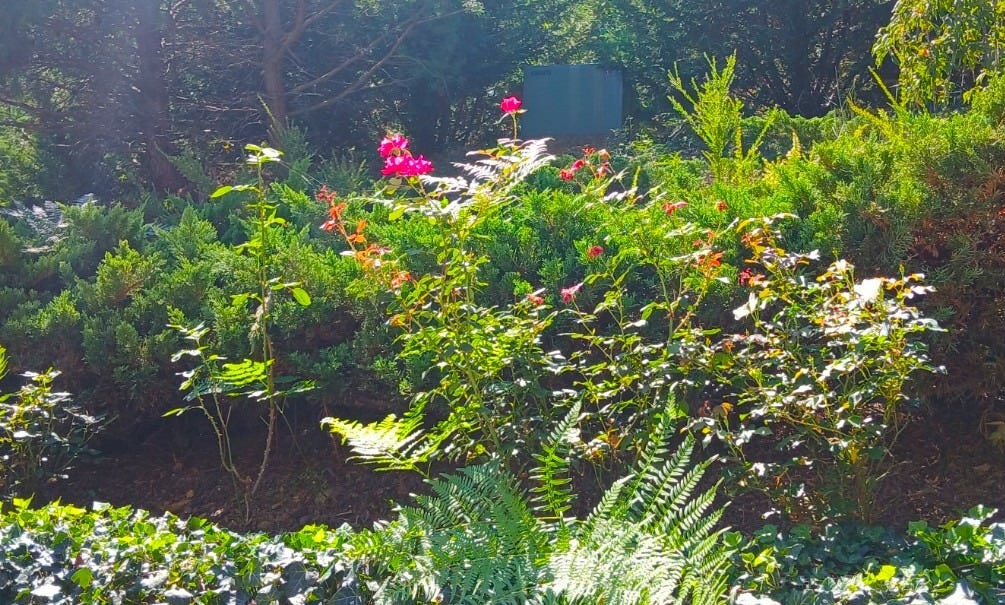
At this point, according to my previous experience, we should be preparing to sing the Irish traditional song “Last Rose of Summer.” And yet, everything is blooming down here.
I thought about cutting the drip frequency in half this week, after Labor Day, but everything is so vibrant that I didn’t have the courage to do it yet.
Let’s give the summer exactly another 13 days, as it’s due! Then you can come back here and “see the colors change”!
Note: Be prepared. Your water bill will go up! Mine did, substantially, but the garden obliged!