
If you came here today you might have spotted something different, and it’s not only the background color.
Yes! The name of our Substack has changed!
But not really. The Porch Gardener was designed to be like this since day one, to follow the seasons. However, I’m certainly excited because this is actually our first seasonal change, with many more to come, I hope.
We should be resting, but instead we will be very busy this fall. We have two species of bulbs in the pantry, awaiting October — drumstick allium and ixia, both supposed to flower profusely in the spring — and our order of lavender and sage (seedlings, not seeds) from American Meadows is scheduled to arrive more or less at the same time to “fill in the blanks” — the flower bed blanks, of course.
I am the eternal optimist (regarding the garden, at least), but I’m also open to accepting my failures and move on to new experiments every year, and every season.
Which takes us to a major problem we have in the garden since we moved here.
The garden is huge, and parts of it are quite inaccessible because the hill is too steep. In two particular sections, the hill and the plot above the flower beds in the main section (I know, I still owe y’all a video tour; it will come eventually, as soon as I stop feeling like an idiot with a cell phone around my neck), the weeds come strongly every summer and turn them into a veritable jungle, pretty ugly to watch.
Last fall (2025) was the first time I made the decision to face the challenge and do something about it, so after a quick research online I bought several pounds of clover, asked my “assistant” to till the land and sowed in September.
The promise was ambitious: These seeds would sprout into a green, luxurious carpet that would immediately win the competition, not only against the weeds, but also against the English ivy that, left unchecked, will cover everything in sight forever, since it is very difficult to eradicate, almost impossible. The beautiful clover, sold as a lawn substitute, would bloom the following spring and, being an evergreen perennial, would come back every year religiously.
Chapter one was successful and uplifting: A couple of weeks after sowing, we did have a “luxurious” green carpet at least on the garden section, not so much on the hill. This was before the drip irrigation, so I did my best to water the sections with a hose and keep everything wet, but not soaked, according to instructions, blah blah blah, a constant hassle.
There was never a carpet of flowers. By the end of the spring, the green carpet started to shrink and had pretty much disappeared by May, even before getting overwhelmingly replaced by the growing weeds in July and August.
There was no trace of the clover left. The jungle had come to reclaim its right, and the clover obliged.
I wrote to American Meadows expressing my disappointment. Customer service there is very nice and the woman was sympathetic, but informed me that I had bought the wrong species of clover and this one was not a perennial and would not come back every year. As a “consolation prize,” I got free shipping on my next order.
Yes, my friends, I sold myself cheap, but what else could I do?
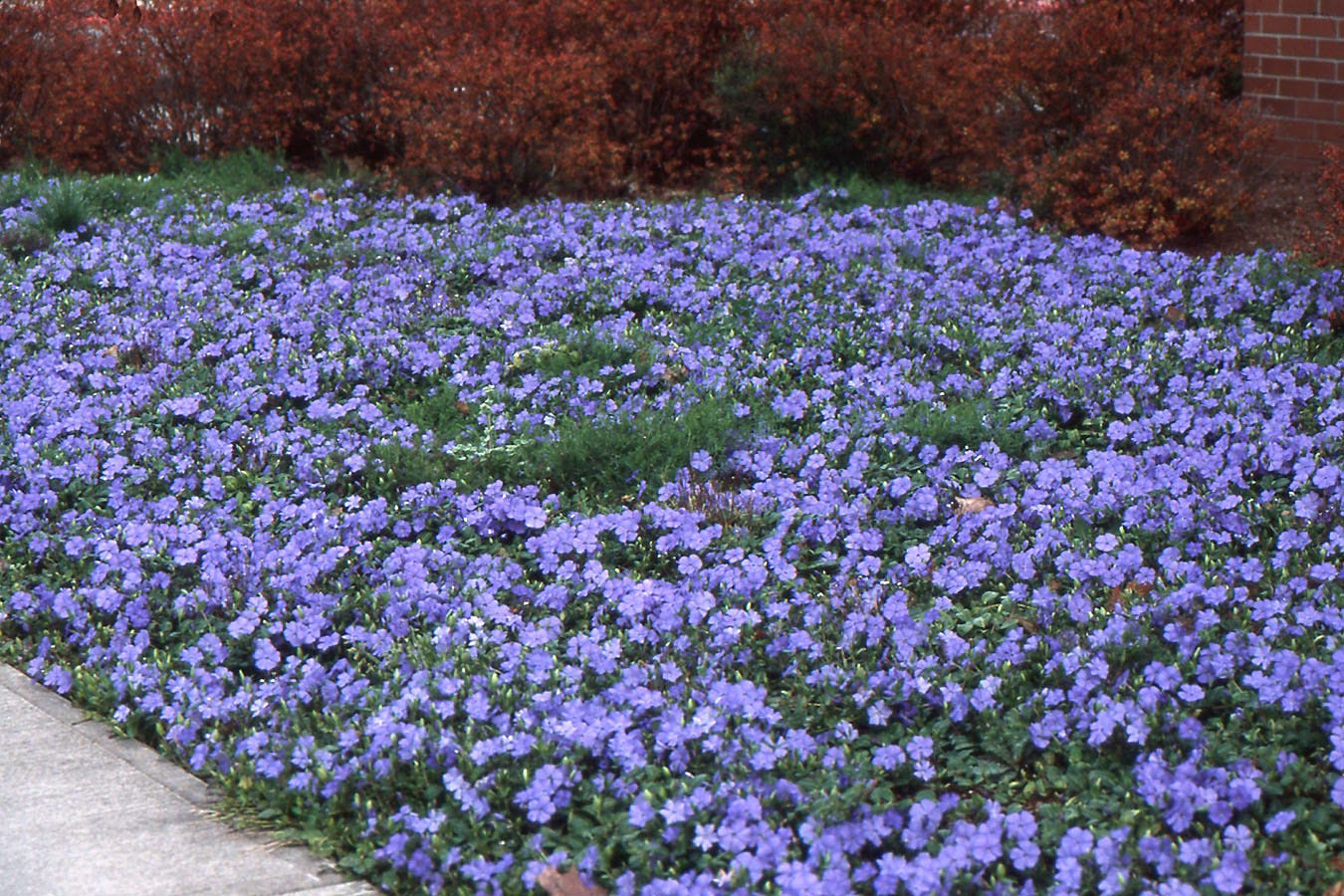
By mid August this year, I was back researching, using Gemini when possible and calling it stupid more often than I would like… until I came to these interesting vincas on Home Depot.
I already had my sights on another variety of vincas since the beginning of summer, but gave up when Gemini told me they were not winter hardy in South Carolina, and as you know I only do non-hardy species very rarely, like in the case of the kalanchoes on our porch, which are brought inside every year for the winter months. These vincas minor, however, appeared to check all the boxes. Except for the fact that they were very expensive, $5.89 per plant at Home Depot.
Do you have the slightest idea of how many plants I would need to make that work?
Exactly. I would probably need a second mortgage to afford that! (Just kidding.)
Well, to make a long story short, and this one is already too long, I have no idea how I ended up on the website of a groundcover provider from Shrub Oak, New York (is this city name for real?), just luck, I guess, but the fact is that the vincas were available there in lots of 100 for $0.60 each!
The rest (will be) history. I bought the plants, and they are scheduled to arrive on week #40, that is, the first week of October.
Lo and behold, today I pulled out all the weeds one by one, buried the drip irrigation hose on that section (which I was already scheduled to do in the fall) and I’m ready to go! On a last note, while pulling the weeds I discovered that the clover is not gone at all… there are hundreds of tiny green leaves sprouting everywhere, so this TPG family will have to figure out a way to live together in harmony. May the best ones win.
Gemini guarantees that planting the vincas in October is the “gold standard,” so help me God!
Vinca minor, Peekskill Nurseries
“Plant 6 to 8 inches apart. Grows 4 to 6 inches off the ground at maturity. Vinca minor likes fairly good soil.” (Peekskill)