
Born at the turn of the 20th century, my grandmother was a young woman living in Tiberias, Israel — which is also my hometown — when someone decided she should immigrate to Brazil and marry her cousin.
We don’t know if bride and groom already knew each other, but rumor has it that, from his porch, my grandfather could say hello to my grandmother down the hill, in her Tiberias garden.
My grandfather lived in Tzfat, the “City of Sages,” but it was my grandmother who allegedly had a distant relative among the wisemen of Israel — a Rambam of sorts — the kind of family ties I would be very much proud of if they were true.
My grandmother was not very popular in the family. She notoriously didn’t like Othello, our black German Shepherd. Check. Neither did I. Othello was huge, and I was terribly afraid of him my whole childhood; maybe that’s why I can’t consider myself a “pet person” even today.
We lived together in the beautifully designed house my grandfather built in Belo Horizonte: my parents, my brother and I occupying most of the first floor and my grandparents the rest of it and the whole second floor, with a courtyard separating the two living areas.
With limited options in a country she could never consider her own, my grandmother decided to dedicate herself to the house. My grandfather was well-off, so we had maids and helpers as is customary in Brazil, but my grandmother was known for her “obsession with cleaning,” a personality trait I also developed later in life, after I turned into an immigrant myself, a few years after meeting my American husband — who was not my cousin, but a complete stranger I met on the internet — at the beginning of the 21st century. Check.
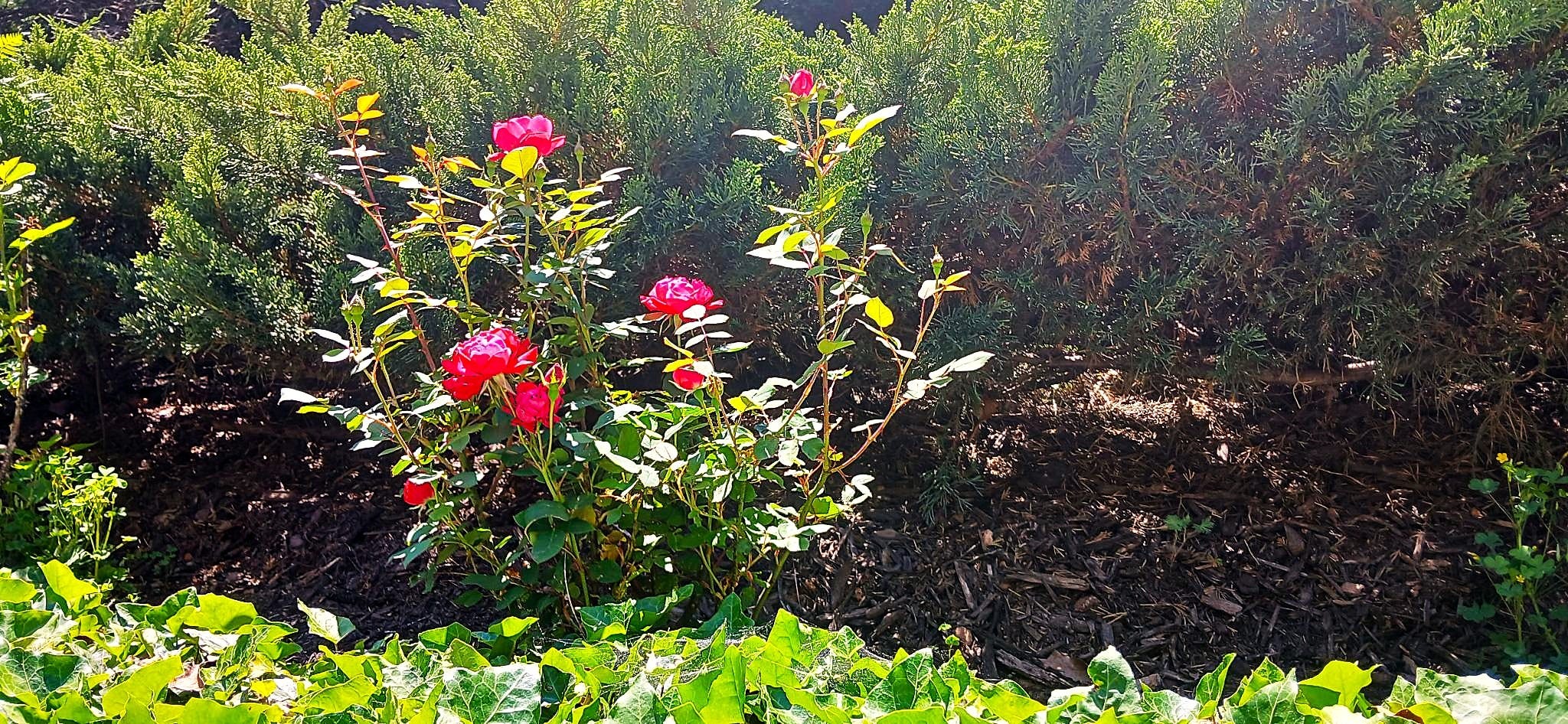
Our house garden was also the “Architectural Digest” kind, beautifully planned with rare tropical flowers and frequently visited by lovers of beauty. As a result, my grandmother didn’t have a lot of gardening opportunities. The garden was too intimidating and my grandfather wouldn’t let her anyway, but it is fair to say that there was a lot more to her than a bad temper and a Yiddish accent. Years later, when my grandfather passed away and she moved to an apartment, she used to cultivate roses on her balcony. Check.
So earlier this morning I was meditating on my wildflower garden when, out of the blue, the memory of my grandmother came to me and I realized we were on the eve of Lag Baomer, the Jewish holiday my grandmother’s birthday was associated with.
Lag Baomer is a happy day. Besides marking the anniversary of the passing of the great sage and mystic Rabbi Shimon bar Yochai, author of the Zohar, it interrupts the sequence of 49 days between Pessach and Shavuot, a period of spiritual transformation and partial mourning (I’m not exactly sure why). The 33rd day of the sequence — Lamed Guimel, Lag — is the only one during this period in which you can celebrate, have weddings and such.
I couldn’t tell why, all of a sudden, I remembered my grandmother after so many years, but I could quickly realize that, as I age, I’m being transformed into a kind of evolved version of her, for which I’m honored.
My grandma Sarah would be 126 years old today, an age she could never reach, but she did very well for herself, dying peacefully in her sleep on her 90th birthday. I hope I’ll check that box too!
One thing my grandmother could not have was the chutzpah to call herself a writer. Not check. She was actually illiterate, and for her whole life wasn’t capable of even reading the newspaper — not in Hebrew, not in Yiddish, not in Portuguese, which probably made her always feel like an outsider. Check that last part.
Nevertheless, she was a woman of fiber and strongly opinionated. Check!
Happy birthday, grandma!