
“I hadn’t quite realized what a hermit I am by nature — the days go by and I have no desire to move from my house and garden.”
Nancy Mitford, Versailles, May 1968
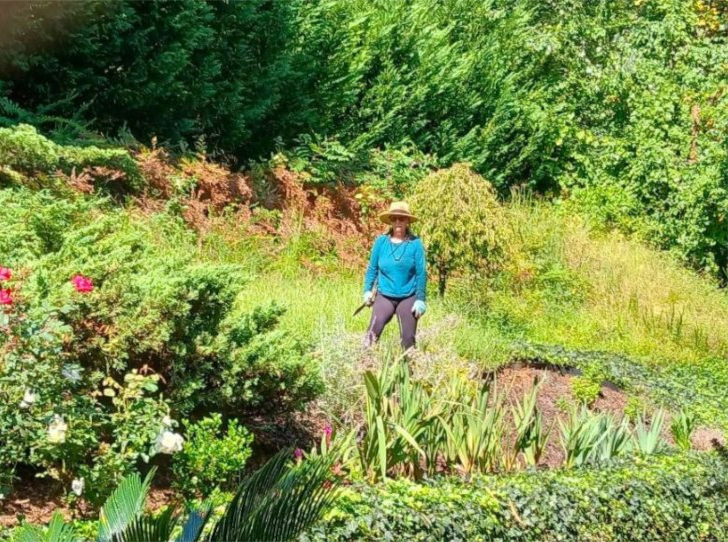
I heard about Nancy Mitford for the first time on BritBox’s wonderful series “Outrageous,” about six sisters from an aristocratic British family during World War II.
Mitford moved to Paris after the war, where she lived on 7, Rue Monsieur (usually mentioned by her as “Mr. Street”) — a “flat with a garden” where she felt like “a totally different person, as if I had come out of a coal mine into daylight.” But it was in her house in Versailles, to which she moved in January 1967, that gardening became one of her chief delights.
I have no idea why writers and gardens are often associated. Maybe it's because you can move elements around freely until you achieve a harmonious whole, much like words in a page.
As for me, lately I started to envision my work in the garden more like that of a “mentor” than a designer: I move plants around, experiment with possibilities, but my real goal, toward which I started to work actively in 2026, is to create a living mix of native vegetation, spot interference and touches of color that hopefully will, in the future, grow profusely together and feed each other.
Part of this “style” of gardening is a constant observation, in order to detect what plants can move from ground to pot or vice-versa, which should be dug out and planted in a more favorable spot, and which could be divided and spread.
September is the official dividing and transplant season, so all my senses are alert toward this goal.
I took a daisy that got too big for her pot on the porch and planted her in my flower plot near the street. Sometimes I even take native South Carolina wildflowers that appeared near the house and move them to a place where they can be “elevated.”
Some of these interferences are successful, others are not, but nothing beats the joy of experimenting with nature.
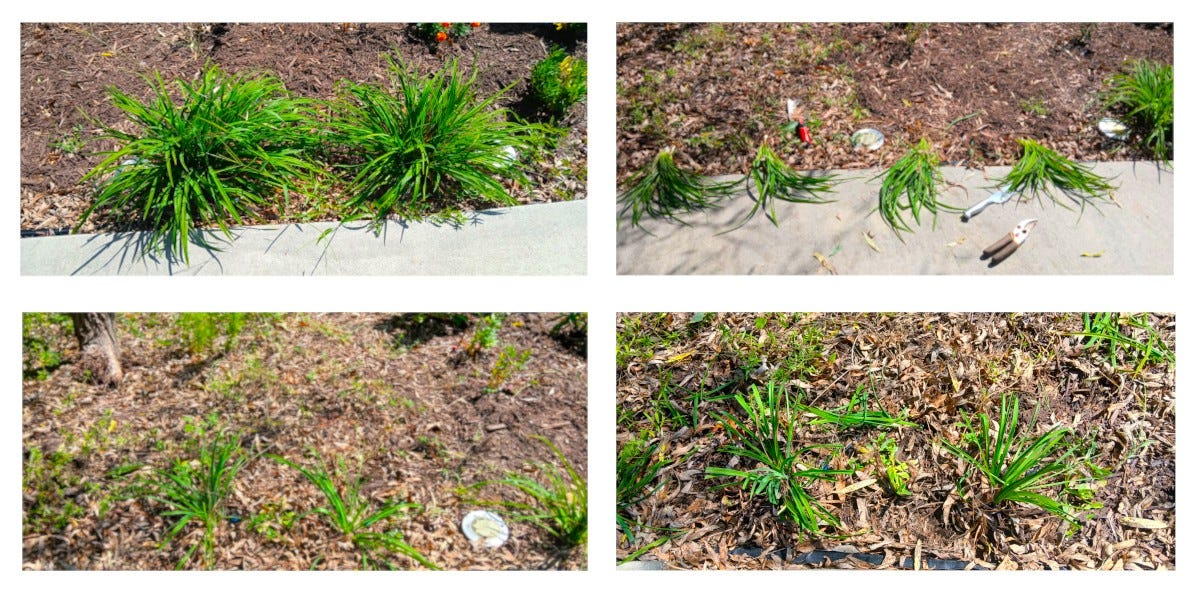
So today, while checking out the flower garden, I noticed that the two daylilies had doubled in size, so I decided to divide them and transform the two into a whole line of daylilies along the driveway.
I should add that “double in size” became the norm in this house after I installed the drip irrigation system. The same happened with a mound of carnations I checked today, whose width has now doubled. I guess my plants were really starving before, even if I watered them regularly with a garden hose!
The “mother daylilies” grew so big that I didn’t even care to take them out of the ground, divide them with a sharp knife, separate the parts, plant them back feet apart, etc., as it’s usually recommended. I simply extracted whole crowns of lilies from the sides and replanted them immediately in a row. If you look at the mother plants, they don’t even seem to have been touched at all.
Shortly after I came inside and proceeded to ask AI if the only seedling that came out practically without roots would survive. AI told me — and I sincerely hope it was not “hallucinating” this time — that it would quickly produce a root, and advised me to just cut the leaves short, to make it easier for the plant to transport water to the top.
So looking clockwise on the image below: extract, move, plant… and cut.
Nancy Mitford’s last years were dominated by illness and pain, although she occasionally still enjoyed working in her garden. We could say that she gardened until she died, something I expect to do myself, except for the illness and pain part, of course, so help me God.
You never know. For now, this routine hard work works for me as a bottomless reservoir of energy. After a few hours gardening, no matter how tired or how miserable I felt when I started, I feel stronger than ever and all my problems seem to disappear.
The effect is later multiplied by the pleasure of moving words around like live plants, here at The Porch Gardener.